
Multnomah County Criminal Court Records
Multnomah County Circuit Court is Oregon's Fourth Judicial District and the primary trial court for felony criminal cases and misdemeanors filed in circuit court. Criminal court records begin when a complaint, information, indictment, citation, or other accusatory filing reaches the court. The District Attorney files most state criminal charges after police referral and review, but the court record is maintained by the Trial Court Administrator / Circuit Court Records Department.
A criminal court record is different from a police report, arrest record, or jail roster entry. Law enforcement creates the arrest or booking record. The court file tracks the prosecution once charges are filed, including court events and case outcome. Charge-level detail is covered more closely in Multnomah County arrest records and court charges, while all case categories are covered in the broader court records page.
The manifest image for the Multnomah County District Attorney home anchors the prosecutor's role in reviewing referrals and filing state criminal charges.
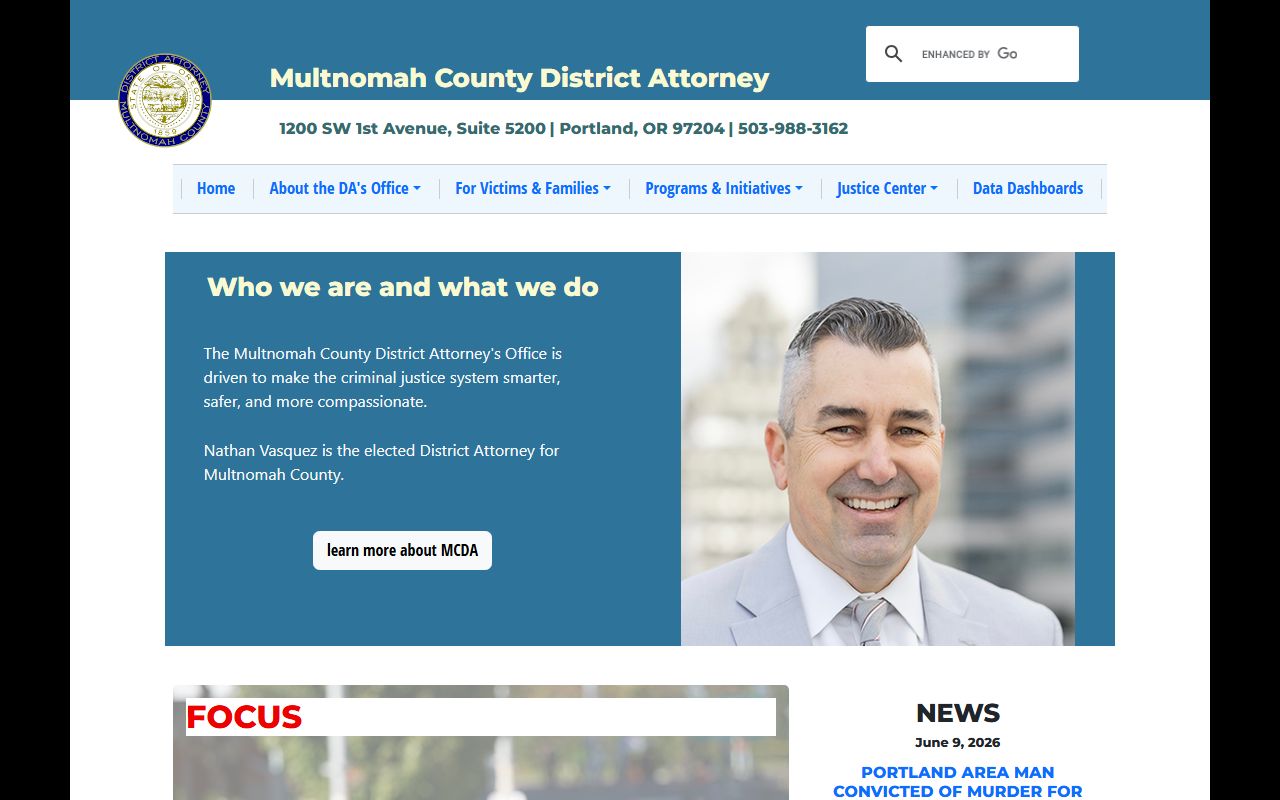
That office role matters because a booking does not become a criminal court case until formal court charges are filed.
Search Multnomah County Criminal Court Records
Criminal case searches use Oregon Judicial Department Records and Calendar Search and Oregon eCourt Case Information. The OECI login page identifies the Register of Actions as the official Oregon circuit court register. Criminal, traffic, and parking searches can be run by case number, cross-reference number, defendant name, business, SID, citation number, attorney name or bar number, and date filed.
- Open the Oregon court case search and choose the criminal, traffic, or parking case search category.
- Select Multnomah County as the location when the portal provides a location filter.
- Search by defendant name, case number, citation number, SID, attorney, or filing date.
- Open the case record and review charges, event entries, hearings, pleas, disposition, and sentencing entries.
- Request certified, exemplified, audio, or document copies from the Records Department when the online record is not enough.
The Multnomah Circuit Court Records Department accepts copy orders online, by email, mail, phone during posted records hours, and in person at the Central Courthouse. For criminal copy requests, the department asks for the defendant date of birth when available, along with the case number, filing date or year, party names, document title, copy type, and delivery method.
Multnomah County Criminal Case Flow
Criminal court records should be read as a sequence. The DA or prosecutor files charges, the defendant appears for arraignment, pretrial events and motions occur, the case resolves by plea or trial, and the court enters disposition and sentencing when applicable. Specialty courts can change that path for eligible cases because treatment and supervision may replace a more ordinary sentencing track.
Case flow: Charges Filed › Arraignment › Pretrial / Motions › Plea or Trial › Disposition › Sentencing
| Stage | What Happens |
|---|---|
| Charges Filed | The complaint, information, indictment, citation, or other accusatory filing starts the court case. |
| Arraignment | The defendant is advised of the charges and rights, and release or future court settings may be addressed. |
| Pretrial / Motions | Attorneys file motions, request orders, exchange case positions, and prepare for plea or trial. |
| Plea or Trial | The case resolves by guilty plea, no contest-type resolution where allowed, trial verdict, dismissal, or other disposition. |
| Sentencing | The court enters penalty terms, probation, custody, fines, restitution, or other conditions after conviction. |
The manifest image for Multnomah treatment courts shows that some criminal cases move through supervised specialty programs.
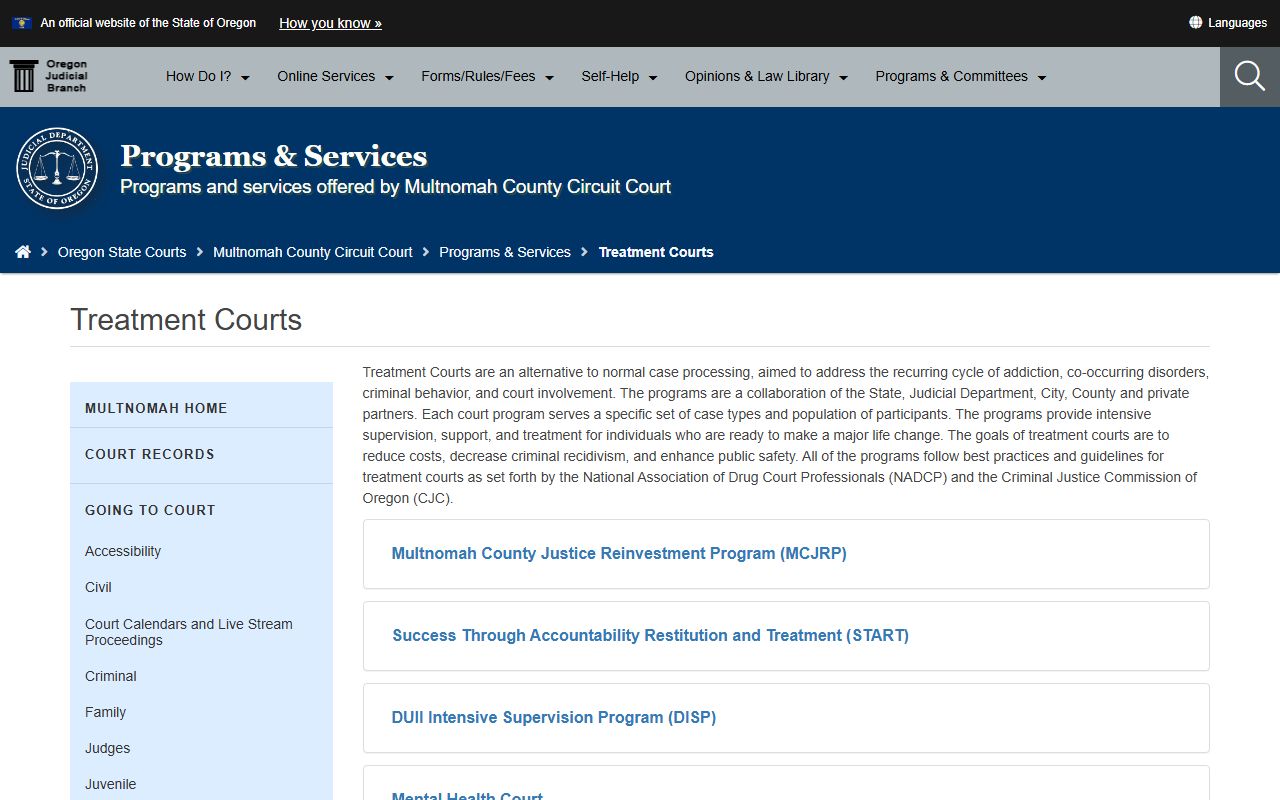
Treatment court participation can appear in the case history as hearings, conditions, supervision events, and outcomes rather than a simple trial path.
What Multnomah County Criminal Records Show
A criminal court record can include the case number, filing date, defendant name, attorneys, charges, arraignment events, warrants linked to the case, court dates, judicial officer, motions, orders, plea entries, disposition, judgment, sentence, probation terms, restitution, fines, fees, and payment obligations. Some information may be redacted, and some records may require a copy order or department review.
| Field | What It Shows |
|---|---|
| Case Number | The court's unique identifier for search, copies, calendars, and payment routing. |
| Defendant | The person charged in the court case, with date of birth used for copy-order identification. |
| Charges | The allegations filed in court and later amended, reduced, dismissed, or resolved when entered. |
| Events | Register of Actions entries such as arraignment, motions, warrants, hearings, orders, and judgment events. |
| Plea | The defendant's formal response or resolution entry when recorded. |
| Disposition | The outcome of each charge or case, such as conviction, dismissal, acquittal, or set aside. |
| Sentence | Custody, probation, fines, restitution, conditions, and related financial obligations. |
Multnomah County Charges vs Convictions
A charge is an accusation filed in court. A conviction is a final result based on a plea or verdict. One Multnomah County criminal court record may show charges that were dismissed, reduced, amended, merged, or resolved with a different final disposition. That is why the charge line and the disposition line must be read together.
| Point | Charge | Conviction |
|---|---|---|
| Case stage | Filed near the start of the court case. | Entered after plea, verdict, or qualifying disposition. |
| Meaning | An allegation made by the state. | A finding or plea that results in guilt. |
| Can change | Can be amended, reduced, dismissed, or added. | Can later be appealed, corrected, or set aside if law allows. |
| How to verify | Read the charging document and later docket entries. | Read the disposition, judgment, and sentence entries. |
Public Access to Criminal Court Records
Oregon public access rules apply differently by record type. ORS 7.010 and ORS 7.020 cover Oregon court records and the court register. Oregon Public Records Law covers public records requests to public bodies. For Multnomah County criminal court records, the practical path is online case search first, then a Circuit Court Records Department request for copies.
Administrative or sheriff records are different channels. Booking records, booking photos, custody records, classification, jail video, courthouse video, and jail phone-call records route through the Multnomah County Public Records Center with the Sheriff's Office selected. The court criminal case file remains with the court records custodian.
The manifest image for the District Attorney contact information reflects the prosecution office's public contact path for case-related DA resources.
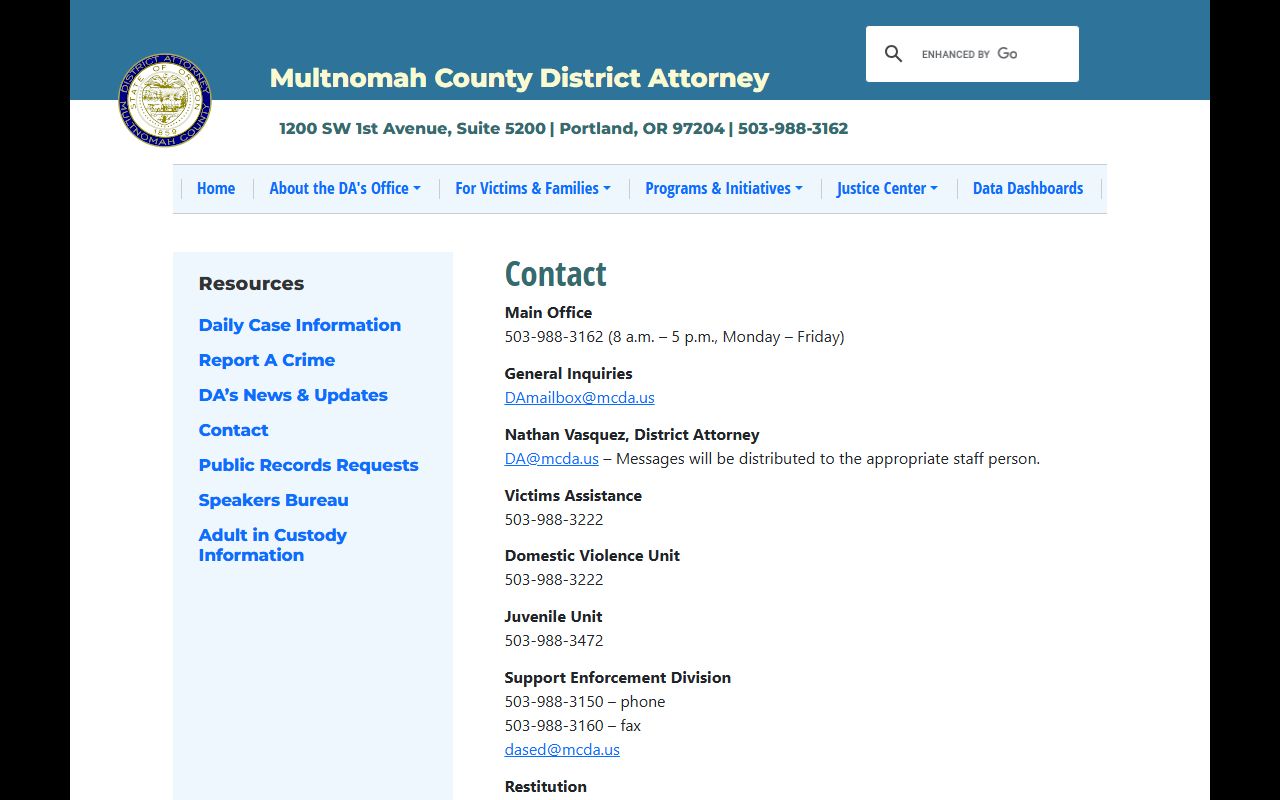
The DA contact path is useful for victim assistance and prosecution-office information, but official court copies still come from the court records office.
Sealed vs Set Aside Records
Oregon commonly uses set aside terminology for many criminal-record clearing questions. Under ORS 137.225, qualifying convictions, contempt findings, arrests, charges, or citations may be set aside through a motion filed in the court where the record occurred. Eligibility depends on the offense, waiting period, sentence compliance, later criminal history, and exclusions.
| Point | Sealed or Confidential | Set Aside Under Oregon Law |
|---|---|---|
| Access effect | Closed from ordinary public access by law or court order. | Public access changes after the court grants a qualifying motion. |
| Common examples | Juvenile, adoption, civil commitment, guardianship, and conservatorship records. | Eligible criminal charges, arrests, citations, contempt findings, or convictions. |
| How it happens | By statute, case type, or court order. | By motion in the court that handled the record. |
| Limits | Authorized people may still have access. | Some government or justice-system uses may remain authorized. |
Multnomah County DA Case Role
The Multnomah County District Attorney is Nathan Vasquez, sworn in January 2, 2025. The DA's primary office is in the Multnomah County Central Courthouse, Suite 5200, with a main office phone of 503-988-3162 and weekday business hours listed as 8:00 a.m. to 5:00 p.m. DA divisions include domestic violence, juvenile, misdemeanor, strategic prosecution, pretrial, extraditions, grand jury, appeals, theft, fraud, drugs, human trafficking, robbery, burglary, weapons, vehicular homicide, assault, sex crimes, homicide, investigations, and body-worn-camera work.
The manifest image for District Attorney divisions and units connects the court record to the prosecution units that may appear in a criminal case history.
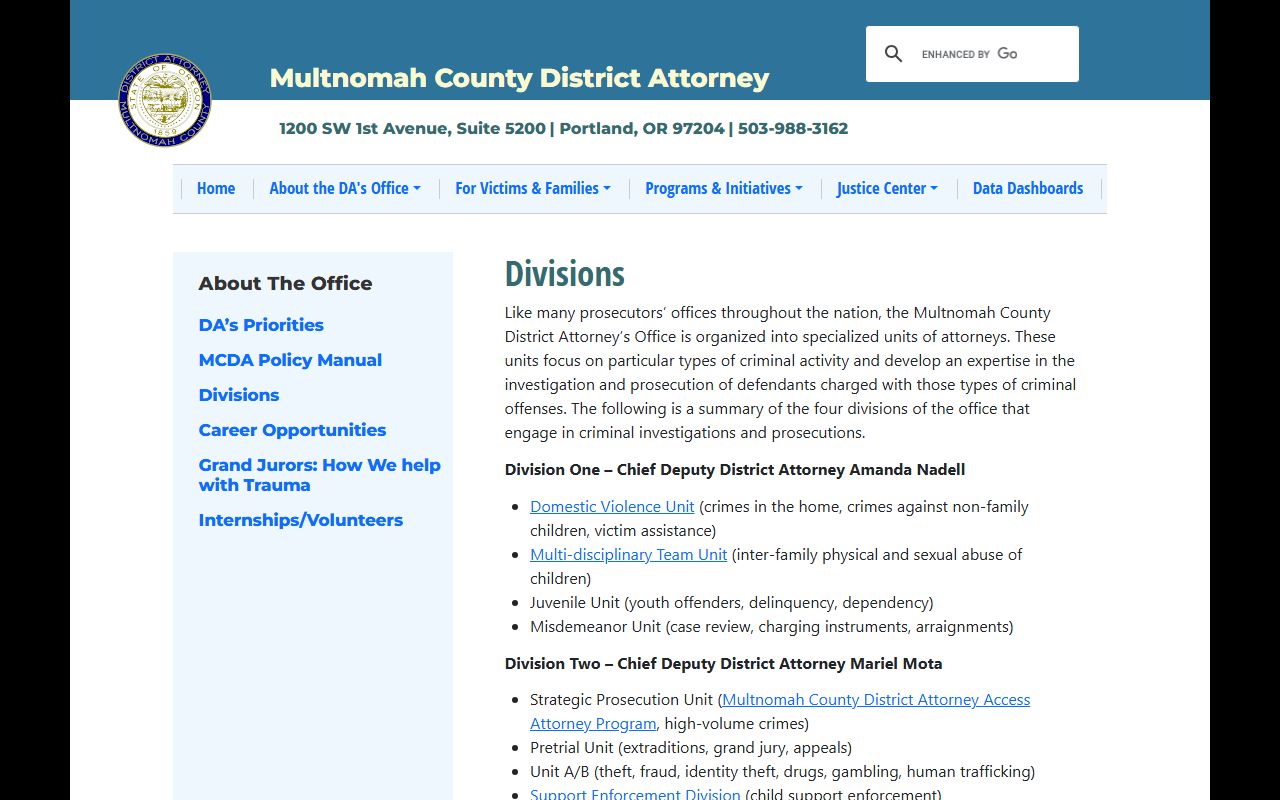
Division names do not replace court records, but they help explain why serious cases can involve specialized DA units before and after filing.
Note: Bring no weapons, pocket knives, multi-tools, scissors, or similar pointed items when visiting the courthouse.
Restricted Multnomah Criminal Records
Juvenile delinquency records are subject to special confidentiality rules under ORS 419A.255. Adult adoption, minor adoption, guardianship, conservatorship, and civil commitment records are also confidential categories on Multnomah's copy-request routing list. Criminal court records involving protected personal identifiers, minor identities, sealed material, or sensitive financial data may be redacted.
A missing online document should not be treated as proof that no record exists. The correct next step may be a department-specific request, attorney access, party status review, court order, or set-aside motion. For custody status rather than the court case file, use MCSO Online Inmate Data or the inmate records page.